
Bicycling Land is reader-supported. When you buy through links on this page we may earn an affiliate commission, at no extra cost to you. As an Amazon Associate we earn from qualifying purchases.
On a 20 mph e-bike, the motor cuts out right where a brisk commute gets going. A Class 3 bike keeps helping to 28 mph, so 10 uninterrupted miles take about 21 minutes instead of 30. Traffic lights shrink that gap, but on a long, open route you’ll feel it every day.
You can get one with a torque sensor and hydraulic brakes for about $1,300 now, but the rules are tighter. In most states, Class 3 bikes stay off multi-use paths, and riders need a helmet and must be 16 or older. My picks are for adult commuters on streets and bike lanes who want brakes and range that hold up at 28 mph.
Prices as of October 2026.
If you only want the short version, start here:
- Best overall: Velotric Discover 3
- Best value: Lectric XPress2
- Best for hills and long range: Aventon Level 4 ADV
- Best for theft protection: Aventon Level 4 REC
- Best mid-drive with a throttle: Velotric Discover M
- Best lightweight pick: Ride1Up Roadster v3
- Best folding: Lectric XP4 750
- Best with dealer service: Specialized Turbo Vado 2 4.0
Class 3 rules to check before you buy
Most states sort e-bikes into three classes. Class 3 is the fast one: the motor helps while you pedal up to 28 mph, then stops. If the system is new to you, our guide to e-bike classes covers the basics.
| Rule | What it usually means for Class 3 |
|---|---|
| Assist speed | Motor helps up to 28 mph while you pedal |
| Multi-use paths | Barred in most states unless the path’s manager allows them |
| Helmet | Required in most states |
| Minimum age | 16 in most states |
| Speedometer | Required on the bike in many states |
| Throttle | Rules vary; California allows none on Class 3 |
The path rule is the one that catches commuters. Still, check before you write off a rail-trail or river path. Minnesota, for one, lets Class 3 bikes use bike paths and shared-use paths unless the agency in charge prohibits it. It also sets the minimum age at 15.
Several bikes below switch between Class 1, 2 and 3 from the display or app. Minnesota groups these “multiple mode” bikes with Class 3 for path access, and other places may too. Ask whoever manages your path before you count on the switch.
Throttles are the murkiest rule. California doesn’t allow one on Class 3, so the Level 4 REC shuts its throttle off there in Class 3 mode. Elsewhere, a Class 3 e-bike with a throttle is common, and six of my eight picks include one.
Cities can stack their own limits on top of state law. New York City has seen bills that would ban Class 3 e-bikes, for example. For the specifics where you live, check our rundown of state-by-state Class 3 rules.
Velotric Discover 3
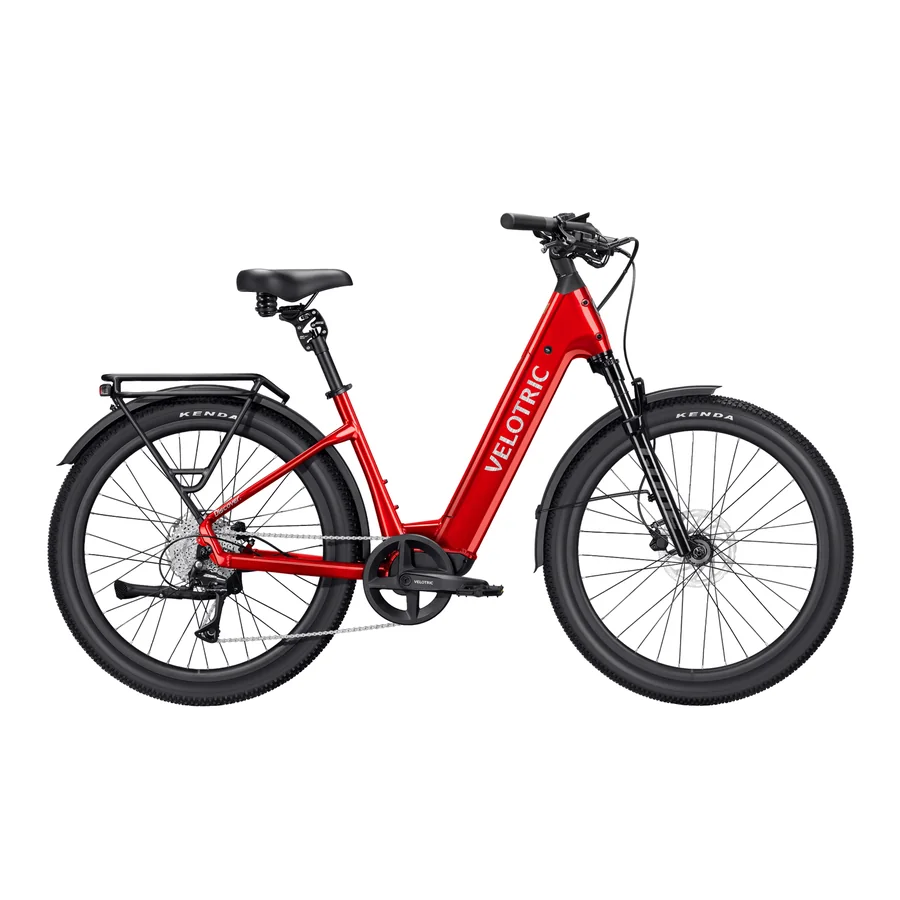
For most people riding to work at 28 mph, the Discover 3 is the bike I’d buy. At $1,999 it gets the basics right and adds the comfort parts that cheaper Class 3 bikes skip.
The motor is a 750W rear hub with 75Nm of torque. (Newton-meters measure twisting force. More torque means quicker starts and easier hills.) Velotric’s SensorSwap lets you choose torque or cadence sensing. A torque sensor reads how hard you push and adds power to match, so the bike feels like a stronger version of you. A cadence sensor only checks that the cranks are turning, which feels more like an on-off switch.
The battery holds 730Wh (watt-hours, the size of the fuel tank). It went 37.4 miles in Turbo, the highest assist level, and 86.7 miles in Eco, the lowest. If you ride near the cap most days, the Turbo number is the safer one to plan around.
Comfort is where it pulls ahead of the cheaper XPress2. The air fork has 80mm (about 3 inches) of travel and can be tuned to your weight with a pump. A lockout stiffens it on smooth pavement. Add a suspension seatpost and 27.5 x 2.4-inch tires, and rough city streets get a lot calmer. Hydraulic disc brakes squeeze 180mm (about 7-inch) rotors.
Commuting gear comes standard: fenders, a rack rated for 66 lbs, a 500-lumen headlight, turn signals and Apple Find My or Google Find Hub tracking. The bike ships at 20 mph. You switch classes from the display, and top speed adjusts from 12 to 28 mph.
There’s a throttle too. Velotric’s app has a Custom Mode that lets it run to 28 mph outside California. Set that way, the bike no longer fits the Class 3 definition, so I’d leave it off.
What I’d watch for:
- It weighed 65 lbs in size Large with fenders and pedals, 4 lbs over the claim.
- The app was buggy at times.
- The Regular size has a minimum saddle height of about 32.6 inches, which can be tall for shorter riders.
The 2-year warranty is twice what Lectric offers. The bike is certified to UL 2849 and the battery to UL 2271.
Lectric XPress2

The XPress2 is the cheapest full-size bike here with the three things I want at 28 mph: a torque sensor, hydraulic brakes and a throttle. It lists at $1,399 and held 28 mph in Class 3 testing. The 750W hub makes 85Nm (1,310W peak), more than the Discover 3.
Lectric’s XPerience Switch flips the sensor between torque and cadence. Stick with torque. In cadence mode, the five assist levels barely differ in speed.
The 672Wh battery is smaller than the Velotric’s, and range shows it: 33.6 miles on high power and 52.6 on low. Brakes use 180mm rotors. A brake light and turn signals come standard, and Lectric’s current promo adds a free rack, fenders and suspension seatpost.
Pros
- Smooth, quiet torque-sensor assist
- Strong hydraulic braking for the price
- UL 2849 bike and UL 2271 battery certification
Cons
- 72 lbs with the battery
- Battery gauge moves in 10% steps, so remaining range is hard to judge
- 1-year warranty
It fits riders from 5 ft 4 in to 6 ft 4 in. For $600 more, the Discover 3 adds an air fork, wider tires, more range and twice the warranty. If your budget is fixed, the XPress2 gives up little that matters on a commute.
Aventon Level 4 ADV

If your commute has real climbs or runs long, the Level 4 ADV is the one I’d pick. At $2,799 it’s the priciest direct-to-consumer bike here, and the money goes into the motor and gearing.
It uses a mid-drive, a motor that sits at the cranks and turns the chain. Because it works through the gears like your legs do, it climbs better and feels more natural than a rear hub motor. Aventon’s Ultro S makes 100Nm, tied with the Discover M for the most on this list.
Range is the other reason to buy it. The 800Wh battery went 54.6 miles in Turbo and 120.8 miles in Eco. No other pick comes close in either mode.
Shifting can be automatic. The Shimano CUES 10-speed uses an electronic shifter, and Autoshift picks the gear for you. The catch: it’s slow when you need several shifts in a row, like dropping gears as you brake for a light at 28 mph. On a stop-and-go route, you’ll notice.
It ships as a Class 1 bike, and you switch it to Class 2 or 3 in the app. In Class 3 it averaged just under 28 mph in speed runs. Brakes are 2-piston Tektro hydraulics on 180mm rotors. The 100mm coil fork uses a thru-axle, a bolt-through axle that holds the front wheel stiffer than a quick-release.
Rack, fenders, integrated lights, a suspension seatpost and 4G/GPS tracking are included. The 4G service is free for the first year, then $2 a month or $20 a year.
At 64.1 lbs, it’s lighter than every hub-drive bike here except the Roadster. Sizes M, L and XL fit riders from 5 ft 3 in to 6 ft 7 in. Two gaps: there’s no brake light, though the taillight and turn signals are wired in, and the throttle isn’t included. If you want one in the box, the Discover M costs $300 less.
Aventon Level 4 REC

Plenty of riders won’t leave a $2,000 e-bike outside work. The Level 4 REC does the most to ease that worry at its price, with 4G/GPS tracking, a built-in e-lock and motion alerts. It replaces the discontinued Level.3 in Aventon’s lineup.
Budget for the service, though. Aventon’s 4G connection is free for the first year, then $2 a month or $20 a year. Some remote features are limited if you let it lapse. Tracking and alerts help you find the bike or know it’s being moved. They won’t stop a thief with a grinder, so I’d still lock it to something solid.
It ships as a Class 2 bike, and you switch to Class 3 in the app. Top speed adjusts 1 mph at a time, handy if you want a lower cap on crowded streets. The 750W hub makes 80Nm, or 96Nm in Boost, its extra-power setting. A throttle, a switchable torque or cadence sensor, a rack, fenders and a suspension seatpost are all included.
The other headline is regenerative braking. When you slow down, the motor works as a generator. It takes some load off the brake pads and sends a little charge back to the battery. Don’t rely on it on long descents, though. On one, it stopped working, likely because the motor got hot.
Range is the weak spot. The bigger motor eats into the 733Wh battery, and it managed 33.4 miles in a real-world run. At the same $1,999, the Discover 3 gives you more range and an air fork. The Aventon gives you the theft protection and regen.
Also know before you buy:
- It weighed 70.3 lbs.
- The charge port sits in an awkward spot.
- The headlight can’t be upgraded.
- In California, switching to Class 3 turns off the throttle.
Velotric Discover M

The Discover M is the mid-drive for riders who still want a throttle. At $2,499 it pairs a 100Nm VeloCore motor with a trigger throttle, cruise control and an 801.6Wh battery. Real-world range runs from 32.3 to 81.2 miles, depending on how hard you lean on the motor.
It’s step-through only, and its fit range is the widest here: 4 ft 11 in to 6 ft 7 in, depending on size and seatpost. That makes it the first bike I’d suggest to a shorter rider. An air fork, a suspension seatpost, Shimano CUES 9-speed gearing and 180mm rotors round it out. The 11-46T cassette (46 teeth on the biggest cog) gives you a very low climbing gear.
Check one thing before you buy. On April 24, 2026, Velotric started a service campaign because some bikes were built with 8mm rear brake rotor and hub bolts that need replacing. Ask Velotric to confirm by serial number that yours has the fix.
Ride quality has rough edges. Motor output and programming were inconsistent at times, and the frame flexes in fast corners. It weighs 66 lbs. Next to the Level 4 ADV, you give up automatic shifting and a good chunk of range, and you save $300 and get a throttle.
Ride1Up Roadster v3

Every other bike here weighs 58 lbs or more. The Roadster v3 came in at 44.1 lbs, light enough to carry up a flight of stairs. It rides more like a regular bike, too, with a stiff frame, hidden cables, 700 x 45c tires and a microShift Advent 9-speed.
The trade-off is power and range. Its 500W geared hub is rated at 50Nm, the lowest torque figure on this list, so steep hills take more of your own effort. The removable 360Wh battery is the smallest here. Measured range ran from 17 to 49 miles, and if you ride fast most days, expect the low end. The Intui-Drive torque sensor helps a lot, since the assist blends with your own pedaling.
It lists from $1,295 for the Rigid to $1,495 for the Suspension, and the chain-drive versions reach 28 mph. Tektro 2-piston hydraulic brakes, a throttle built into the OLED display and alloy fenders come standard. A rack costs extra.
Two small fixes I’d budget for. The grip-tape pedals let feet slip, and the taillight doesn’t work as a brake light. Decent flat pedals and a brake-sensing rear light solve both.
Lectric XP4 750

The XP4 750 is the 28 mph bike for people with no room for a full-size one. It folds to 37 x 17 x 29 inches, small enough for a car trunk, an RV or an apartment closet. At $1,299, it’s also among the least expensive bikes here.
Its removable 840Wh battery is the biggest on this list. On throttle alone, which tops out at 20 mph, it went 36.7 miles. Pedal assist reaches 28 mph through a torque-sensing 750W hub with 85Nm. Brakes are hydraulic with 180mm rotors, and the rear rack is rated to 150 lbs.
Folding doesn’t make it light. It weighed 72 lbs, the same as the full-size XPress2. Power also comes on abruptly, and the frame has some rattles. Assembly is quick and tool-free, though. If folding matters more than speed, our list of the best folding electric bikes compares more models by weight and range.
Specialized Turbo Vado 2 4.0

The Turbo Vado costs about twice as much as the Discover 3, and a big part of what you pay for is the shop down the street. Specialized sells it through dealers, with in-store pickup instead of shipping to your door. For a daily commuter racking up miles, a local mechanic who knows the bike is worth real money.
Don’t judge the motor by its specs. The Specialized 2.0 mid-drive is rated at 250W nominal and 70Nm, modest on paper, yet it’s one of the best-feeling e-bike motors around. The MasterMind TCD display is well laid out, gets over-the-air updates and has a motor lock for theft protection.
The integrated 710Wh battery is removable and lockable. Specialized claims up to 90 miles in Eco. The earlier Turbo Vado 4.0 went 61 miles in Eco and 23.4 miles in Turbo, a steep drop at full power. You also get fenders, front and rear LED lights, a rack rated for about 60 lbs, Shimano CUES 9-speed gearing and Shimano hydraulic brakes with 180mm rotors.
It lists at $4,099.99, though some Step-Through colorways are listed at $3,249.99 to $3,499.99. It weighs about 58 lbs in size Medium. The wide handlebar can snag on doorways, and the magnetic charger is fiddly to seat with the battery in the frame.
How to choose a Class 3 commuter e-bike
Small spec differences turn into big ones at 28 mph. Here’s what I’d check, roughly in order of importance.
Brakes and rotor size
I wouldn’t buy a Class 3 bike without hydraulic disc brakes, and every pick here has them. Fluid in the line pushes the pads, so you get more stopping power for less hand effort than with cable brakes.
Rotor size matters too. A bigger rotor puts the pads farther from the hub, so the same squeeze slows the wheel harder. The extra metal also sheds heat on long descents. Six of my eight picks list 180mm rotors. Spec sheets also mention 2-piston brakes, which means one piston on each side of the caliper pushing a pad onto the rotor.
Torque sensor or cadence sensor
I covered how the two work under the Discover 3. In traffic at 28 mph, I want torque sensing, because the bike surges only when I push and eases off when I do. Every hub-drive pick here has a torque sensor, and the XPress2, Level 4 REC, Discover 3 and Discover M can switch to cadence mode too.
Hub motor or mid-drive
A hub motor sits in the rear wheel. It’s cheaper and simpler, and you’ll find one on both Lectrics, the Discover 3, the Level 4 REC and the Roadster. A mid-drive turns the chain from the cranks, so it uses the bike’s gears. That pays off on hills and usually feels more natural. It also costs more: the mid-drives here run $2,499 to $4,099.99.
There’s an ownership cost, too. A mid-drive sends all its power through the chain and cassette, so those parts wear faster than on a hub-drive bike. Ease off the pedals for a moment as you shift, and check the chain for wear more often than you would on a regular bike.
Don’t shop by watts. The Turbo Vado has the lowest rating here at 250W nominal and one of the most refined motors. Torque (in Nm) says more about starts and hills, and the sensor says more about how the ride feels.
Speedometer and display
Many state Class 3 laws require a speedometer, and you’ll want one anyway on streets posted at 25 mph. Pay attention to the battery readout as well. The XPress2’s gauge moves in 10% steps, which makes it hard to know whether you’ll make it home. The Level 4 REC sets top speed 1 mph at a time, and both Velotrics adjust from 12 to 28 mph. That’s useful where a path or campus posts a lower limit.
Weight and storage
Six of my picks weigh between 64 and 72 lbs. That’s fine if you roll into a garage or a ground-floor bike room. If you carry the bike upstairs, the 44-lb Roadster is the only one here I’d pick. Check the load rating too: both Velotrics allow 440 lbs total for bike, rider and cargo, while the Aventons list 300 lbs.
Throttle
A throttle gets you moving from a stop without a hard pedal stroke, which helps at busy intersections. On Class 3 bikes it’s often limited. The XP4’s throttle stops at 20 mph, and the Level 4 ADV doesn’t include one at all. If a throttle matters more to you than 28 mph assist, a Class 2 e-bike with a throttle may suit you better.
Certification, warranty and service
UL 2849 covers the bike’s whole electrical system, and UL 2271 covers the battery. The XPress2, Discover 3, Level 4 ADV and Roadster list UL 2849 certification, and Aventon says the Level 4 REC’s system and battery are UL-certified. Warranties run from 1 year on the Lectrics to 2 years on the Discover 3. With any direct-to-consumer bike, find a local shop that will work on it before you need one.
What your budget buys
- About $1,300 to $1,500: hub motor, torque sensor and hydraulic brakes (XP4 750, XPress2, Roadster v3)
- About $2,000: more comfort parts, app control and better theft protection (Discover 3, Level 4 REC)
- $2,500 to $2,800: mid-drive climbing torque (Discover M, Level 4 ADV)
- $4,000 and up: dealer service and a refined motor (Turbo Vado 2 4.0)
Range at 28 mph vs. 20 mph
None of these bikes lists its range at a steady 28 mph. But the physics is clear. The power needed to beat air drag rises with the cube of your speed, so 28 mph takes about 2.7 times the power of 20 mph.
The closest real numbers come from runs in each bike’s highest and lowest assist levels. The short runs are the better guide if you ride near the cap. The long runs show what easy, slower riding can stretch to. Neither is a fixed-speed result.
| Bike | Battery | Claimed | Shortest run | Longest run |
|---|---|---|---|---|
| Aventon Level 4 ADV | 800Wh | 110 mi | 54.6 mi | 120.8 mi |
| Velotric Discover 3 | 730Wh | 80 mi | 37.4 mi | 86.7 mi |
| Velotric Discover M | 801.6Wh | 95 mi | 32.3 mi | 81.2 mi |
| Lectric XPress2 | 672Wh | 60 mi | 33.6 mi | 52.6 mi |
| Ride1Up Roadster v3 | 360Wh | 20-40 mi | 17 mi | 49 mi |
For the Level 4 ADV, Discover 3 and XPress2, the short runs came in top assist and the long ones in the lowest level. The drop is steep. The Discover 3’s short run was 57% below its long one, the Level 4 ADV’s 55% and the XPress2’s 36%. Against the claimed figure, plan on about half when you ride hard.
Three bikes sit outside the table. The Level 4 REC went 33.4 miles against a 75-mile claim. The XP4 750 went 36.7 miles on throttle alone, capped at 20 mph, against an 85-mile claim. The Turbo Vado’s numbers come from the earlier Turbo Vado 4.0: 61 miles in Eco and 23.4 in Turbo.
My planning rule: start from the shortest run, then hold back about 20% for cold weather, headwinds and an aging battery. Treat that 20% as a floor. A cold, windy winter commute can eat more. If your round trip still doesn’t fit, charge at work.
That’s easier when the battery comes out. The XP4 750, Level 4 REC, Roadster v3 and Turbo Vado all have removable batteries. The pack can charge at your desk while the bike stays locked outside. Check the charge time for the included charger before you count on a lunchtime top-up. On days you’re not in a hurry, a lower assist level stretches the battery a long way.
Helmet and lights for 28 mph
Most states require a helmet on a Class 3 bike, and every bike helmet sold in the US must meet the CPSC standard. That’s the floor. For 28 mph, I’d look for one also certified to NTA 8776, a Dutch standard written for speed pedelecs, e-bikes that assist up to about 28 mph. NTA 8776 helmets are tested at higher impact speeds and cover more of the head, especially around the temples and the back.
For models to consider, see our picks for NTA 8776 helmets.
Lights matter more at 28 mph, because drivers don’t expect a bike to close the gap that fast. Here’s what I’d set up:
- Headlight: bright enough to see well ahead at speed. The Discover 3’s 500-lumen light is a decent baseline. The Level 4 REC’s headlight can’t be upgraded, so I’d add a bar-mounted light.
- Brake light: the XPress2 has one. The Roadster and Level 4 ADV don’t, and a brake-sensing taillight is a cheap fix.
- Daytime flash: run front and rear lights in flash mode during the day, too.
Class 3 e-bike questions
How fast is a Class 3 e-bike?
The motor helps up to 28 mph while you pedal, then cuts out. You can go faster on your own legs or downhill, just without assist. That’s also the answer if you’re hunting for the fastest Class 3 e-bike: none of them assists past 28 mph. What differs is how well a bike holds the cap. The XPress2 held 28 mph, and the Level 4 ADV averaged just under it.
Which Class 3 e-bike has the longest range?
Of my picks, the Aventon Level 4 ADV. Even its Turbo result of 54.6 miles beats the best runs of the XPress2 and Roadster. If $2,799 is too much, the $1,999 Discover 3 is the long-range pick for less money.
What’s the best Class 3 e-bike in 2026?
For most commuters, the Velotric Discover 3. If you’d rather spend $600 less, the XPress2 keeps the torque sensor, hydraulic brakes and throttle. If you’d rather spend more, I’d step up to the Level 4 ADV for hills, or to the Turbo Vado if a local dealer matters most.
Are there Class 4 e-bikes?
No. The three-class system US states use stops at Class 3. A bike that assists past 28 mph, or a throttle that runs beyond the class limits, falls outside the e-bike definition. Depending on the state, that can make it a moped or motor vehicle, with registration, insurance or license rules. Velotric’s Custom Mode is a good example: let the throttle run to 28 mph and the Discover 3 stops being a Class 3 bike.
Photo: Kenilworth Trail Bicycle Commuter Trail Minneapolis 15862340925 by Tony Webster, CC BY-SA 4.0, via Wikimedia Commons. Cropped.

